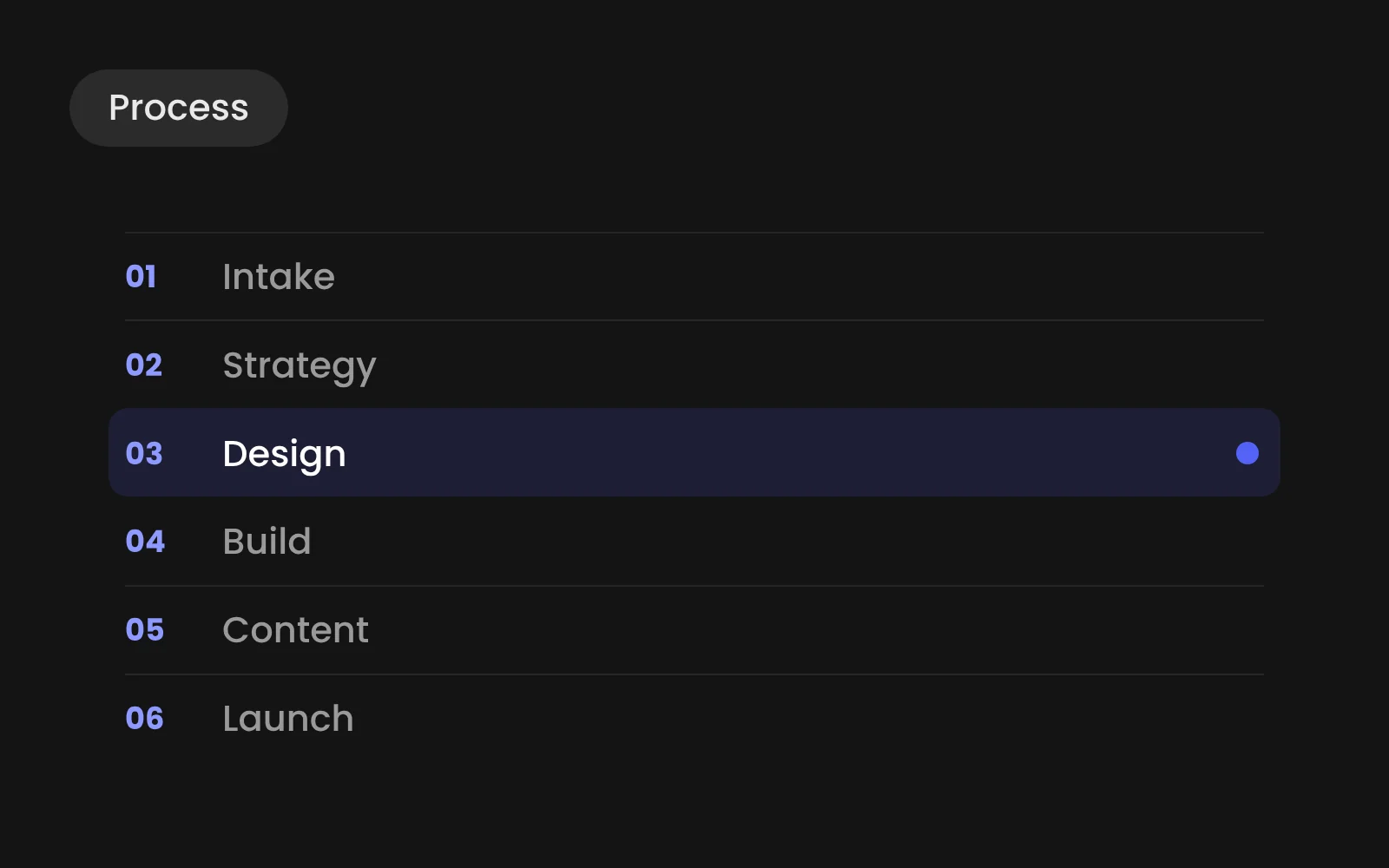
Whoever builds your site, the work follows roughly the same order. Knowing that order helps you plan your own time, judge a proposal and spot where a project can stall. Below is how it runs at Digitalmakers, with the time each step takes.
The six steps at a glance
- Brief and strategy. Goals, audience, sitemap and content plan. About one week.
- Design. Key pages first, then the design system. One to two weeks, with two feedback rounds.
- Build. Components, CMS and interactions. One to three weeks.
- Content and SEO. Copy, metadata and redirects in place. About one week, partly alongside the build.
- Testing. Speed, accessibility, devices and forms. A few days.
- Launch and handover. Go live, training and first checks. Two to three days.
Together that is 4 to 8 weeks for a typical B2B site. Larger sites with several languages or integrations take longer.
1. Brief and strategy
The start is what the site needs to do, not what it should look like. Who visits, what do they need to believe, and what should they do next? The result is a sitemap, a content plan and agreement on how success gets measured. Scope gets fixed here, and with it the budget; see What does a website cost in 2026?
2. Design
We design the key pages first, usually the homepage, a service page and a case, in Figma. Once those are approved, the rest follows from a design system: colours, type, spacing and components such as cards, quotes and forms. That system is what makes the site easy to extend later.
3. Build
The design system becomes a component library in Webflow. Pages are built from those components, so your team can make new pages without breaking anything. Content that repeats, such as cases, articles or vacancies, gets its own CMS collection. Forms are connected to your CRM where needed.
4. Content and SEO
Copy goes in, together with titles, meta descriptions, alt texts and structured data. If the new site replaces an old one, every old URL gets a new home or a redirect, so search rankings carry over. See WordPress to Webflow without losing SEO.
5. Testing
We test on phones, tablets and wide screens, check page speed, run an accessibility check and send every form to its destination. You get a test link for your own round.
6. Launch and handover
We connect the domain, submit the sitemap to Google and Bing and watch the first days closely. In a handover session your team learns to edit text, add CMS items and build new pages from components.
What you deliver along the way
- A kick-off with the people who decide
- Two or three sites you like, and why
- Feedback on design within the agreed rounds
- Final copy, or time to approve copy we write
- Access to the domain and the systems the site connects to
What slows projects down
In our experience, three things: content that arrives late, feedback rounds with too many people, and decisions that get reopened after approval. Name one decision maker on your side and the timeline holds.